LightMem: Lightweight and Efficient Memory-Augmented Generation

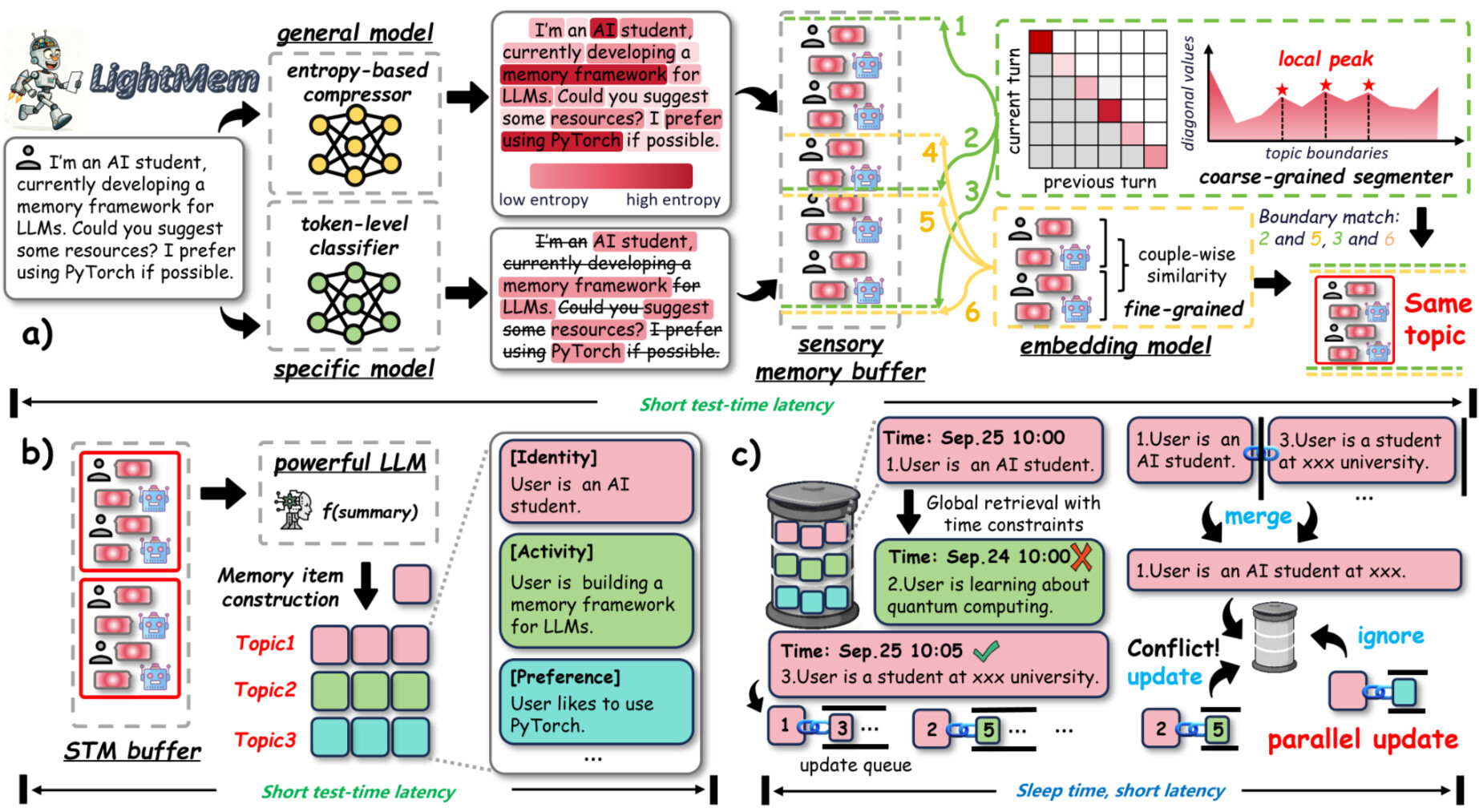
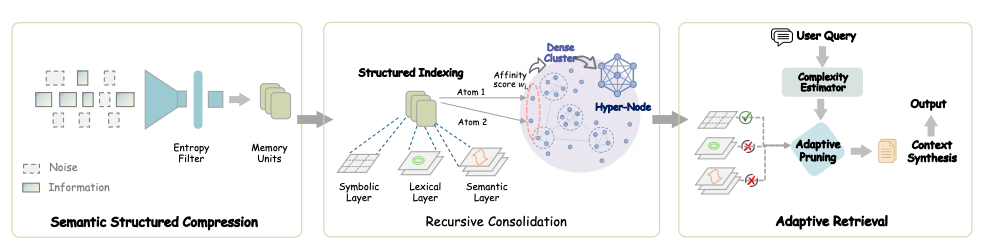
This post summarizes LightMem: Lightweight and Efficient Memory-Augmented Generation. The easiest way to give an LLM agent memory of past conversation is to stuff the whole history back into the prompt every time. That approach falls apart as conversations grow. A long context triggers the “Lost in the Middle” problem, where the model ignores information buried in the middle, and memory systems that re-read the accumulated history on every turn pay for it with higher compute and slower responses. LightMem targets both problems at once. It’s a lightweight memory-generation system that cuts token usage to a fraction of what existing systems need, while outperforming them. ...

April 6, 2026 · 4 min · Donghyung Ko

Ego-Splitting Framework: from Non-Overlapping to Overlapping Clusters

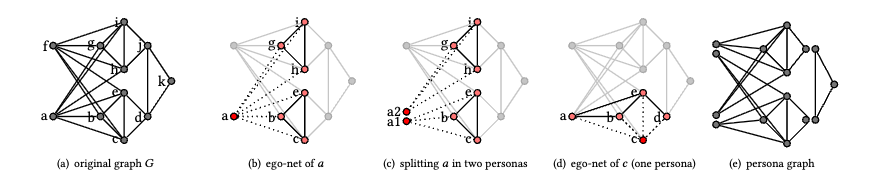
This post summarizes Google’s 2017 KDD paper Ego-Splitting Framework: from Non-Overlapping to Overlapping Clusters. Why Non-Overlapping Clustering Falls Short Real-world networks tend to have plenty of medium-sized communities (roughly 100 members), and a single node frequently belongs to several of them at once. Non-overlapping clustering algorithms assign each node to exactly one community, so they can’t capture that structure. Algorithms that attempt overlapping clustering already existed, but most were either too complex, too inflexible, or lacking in theoretical guarantees. ...

March 27, 2026 · 4 min · Donghyung Ko

Community Detection

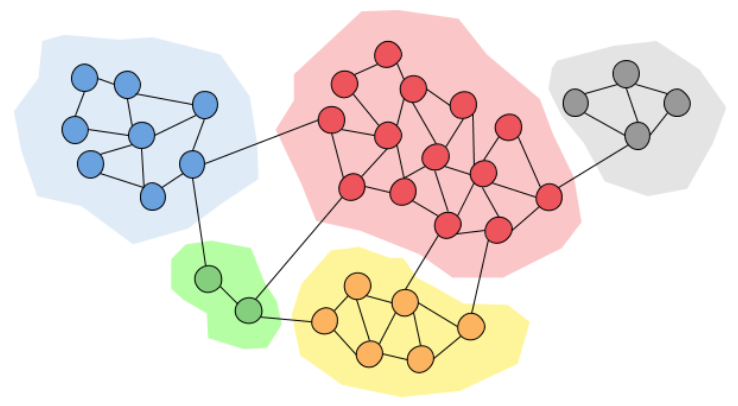
Community detection is the problem of finding sets of densely connected nodes, communities, inside a graph. Think of it as a form of clustering. Methods like GraphRAG use exactly this technique to break a knowledge graph into manageable pieces. This post covers where modularity, the most widely used metric in community detection, comes from, and how the two algorithms most commonly used to optimize it, Louvain and Leiden, differ. Modularity: Measuring How Well-Formed a Community Is Say you’ve formed a community. What does it mean for that community to be “good”? The most common answer in community detection is a metric called modularity. The intuition is simple: compute how many edges you’d expect inside this community if the graph’s edges were wired up completely at random, then measure how far the observed edge count exceeds that expectation. If the connections are too dense to explain away as coincidence, that’s evidence you’ve found a real community. ...

March 23, 2026 · 5 min · Donghyung Ko

GraphRAG

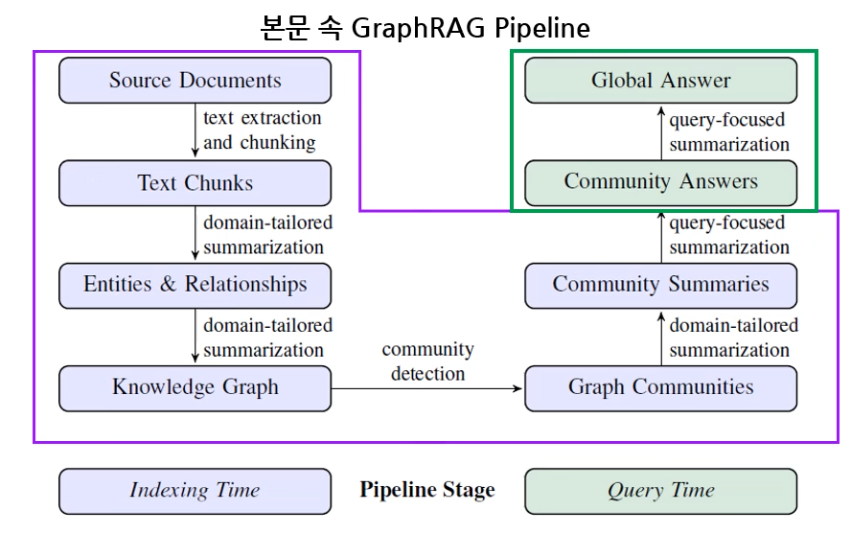
This post summarizes the Microsoft Research paper From Local to Global: A GraphRAG Approach to Query-Focused Summarization, also drawing on the video [Paper Review] GraphRAG by Seoul National University’s DSBA Lab. RAG works by building a trusted document collection ahead of time, then, when a question comes in, retrieving the relevant documents and handing them to an LLM as grounding for its answer. The basic pieces are indexing (chunking documents into a searchable form), retrieval (finding documents relevant to the question), and generation (producing an answer from the retrieved documents and the question). ...

March 13, 2026 · 7 min · Donghyung Ko
Diagram of the 3-stage SimpleMem pipeline

[Paper Review] SimpleMem: Efficient Lifelong Memory for LLM Agents

This post is a review of SimpleMem: Efficient Lifelong Memory for LLM Agents. Some parts of the paper have been updated after this post was written (2026-01-24), so there may be differences from the version discussed here. Background LLMs are stateless. As a result, previous inference outputs do not directly affect later outputs. Because of this property, a plain LLM can fail to maintain continuity in long conversations. In other words, it may look like short-term memory loss, where it cannot remember what was just discussed. ...

January 24, 2026 · 5 min · Donghyung Ko

SIMA: A Generalist AI Agent for 3D Virtual Environments

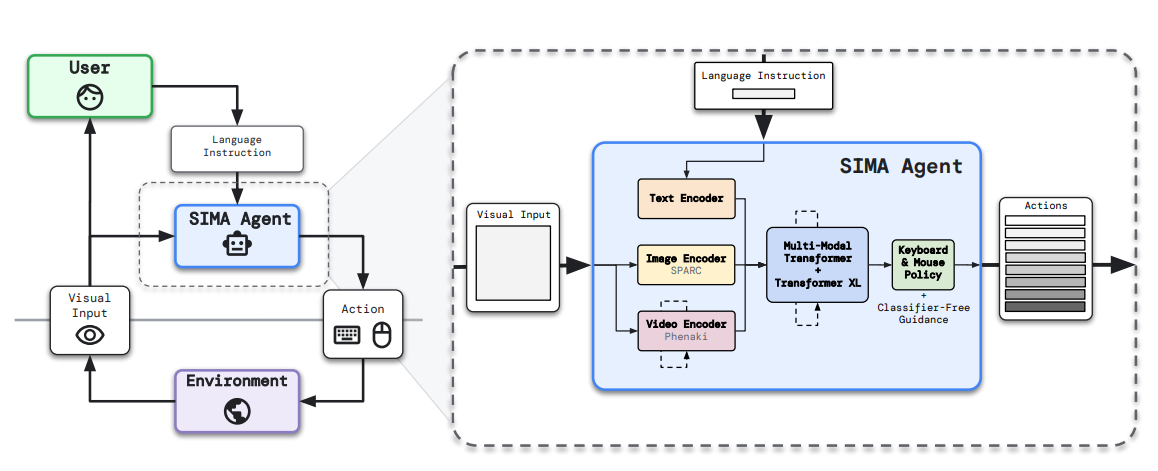
SIMA (Scalable Instructable Multiworld Agent), which DeepMind published in 2024, is a generalist agent built for 3D virtual environments. Give it a screen and a simple natural-language instruction, and it plays a 3D game almost the way a human would. Not One Game, But Many SIMA isn’t a bot tuned for one specific game, and that’s what makes it interesting. Working with eight game studios, DeepMind trained it across nine titles, including No Man’s Sky (exploring alien planets), Satisfactory (building automated factories on an alien world), and Valheim (a Norse-mythology survival crafting game). It can follow human instructions and play games it has never seen before. ...

November 16, 2025 · 3 min · Donghyung Ko