A Kafka partition has always been limited to one consumer at a time. That coupled partition count and consumer count tightly together, and scaling throughput often meant splitting a topic into far more partitions than the data itself justified. Plenty of workloads fit a queue-style model better, where several consumers split the work on one partition, but the old structure had no way to express that. KIP-932: Queues for Kafka removes that constraint with a new group type: the Share Group.
Share Group
A Share Group is a new group type (share) that sits alongside the traditional consumer group. The biggest difference: multiple consumers can share a single partition at the same time. A group’s consumer count can exceed the topic’s total partition count, acknowledgment happens per record, and each message tracks how many times it’s been delivered.
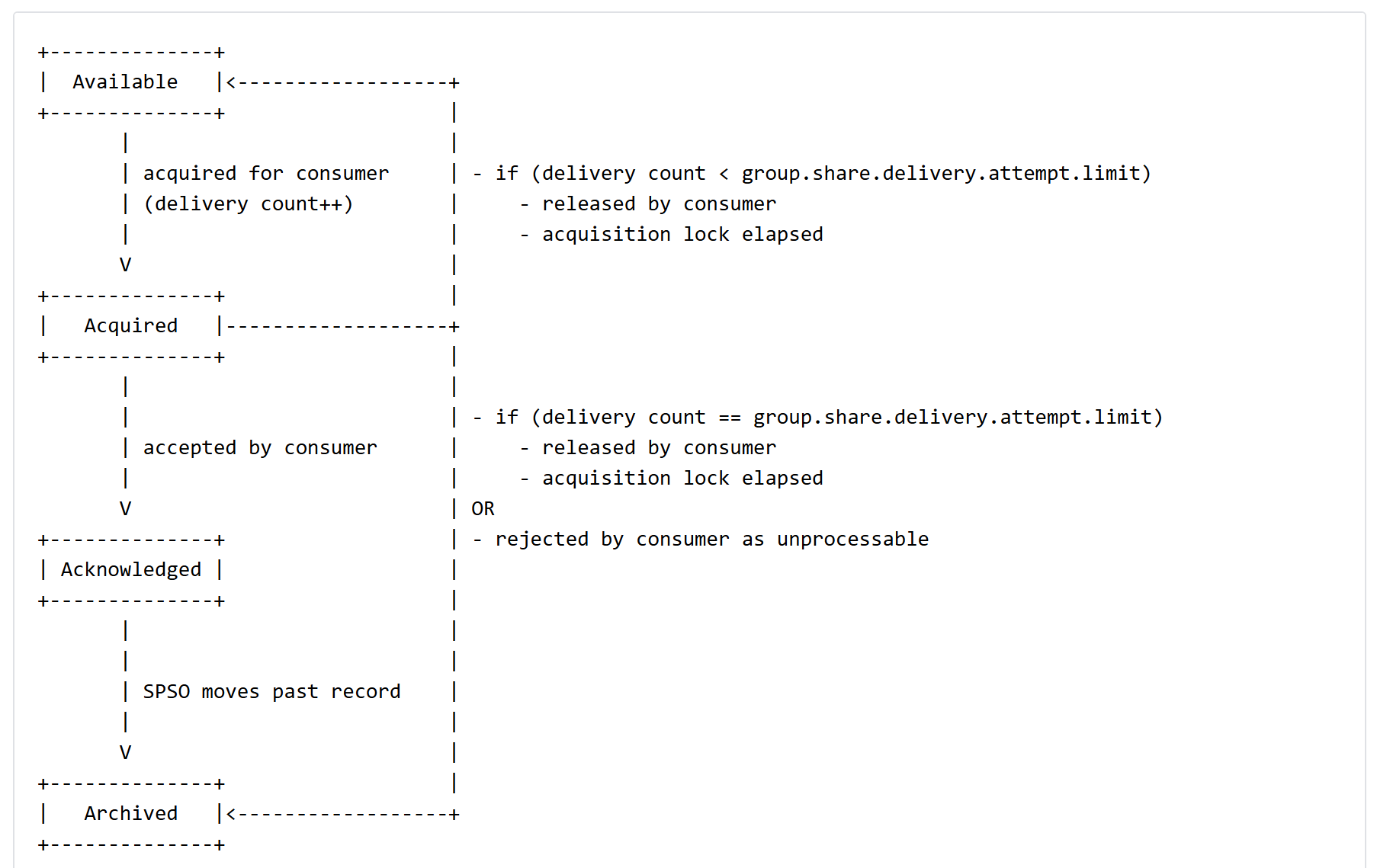
When a consumer in a Share Group reads a record, that record enters the Acquired state for a fixed window (30 seconds by default), during which no other consumer can touch it. From there, a consumer can take one of four actions: acknowledge, marking the record processed successfully; release, unlocking it so another consumer can pick it up; reject, marking it unprocessable and moving it to Archived; or do nothing, in which case it auto-releases once the window expires. Once a record exceeds its configured retry count, it moves to Archived and stops being delivered to anyone.
Record Lifecycle
A record in a Share Group moves through four states: Available, meaning it hasn’t been delivered and can go to any consumer; Acquired, meaning it’s held by a specific consumer under something like a time-limited lock; Acknowledged, meaning processing finished successfully; and Archived, meaning it either exceeded its retry count or finished processing, and won’t be delivered again.
Share-Partition
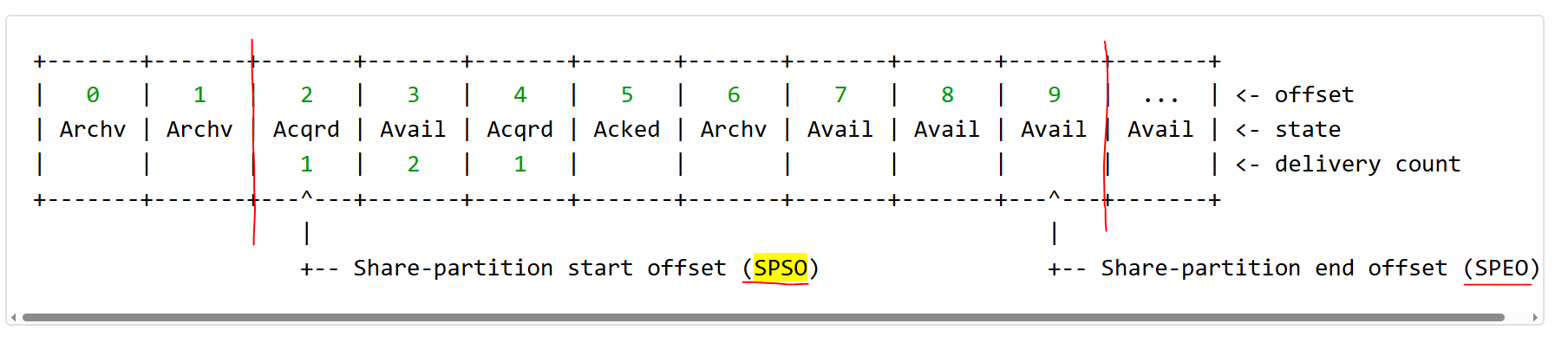
A Share Group is managed at the granularity of a Share-Partition, which holds the mapping between a Share-Group and a Topic-Partition and serves as the basic unit for tracking in-flight records and state.
Two offsets sit at the center of this: SPSO (Share-Partition Start Offset) and SPEO (Share-Partition End Offset). SPSO marks the start of the consumable range and moves right as messages get acknowledged. SPEO marks the end of the current in-flight window and moves right as consumers fetch more messages. The span between them is the in-flight window.
Architecture
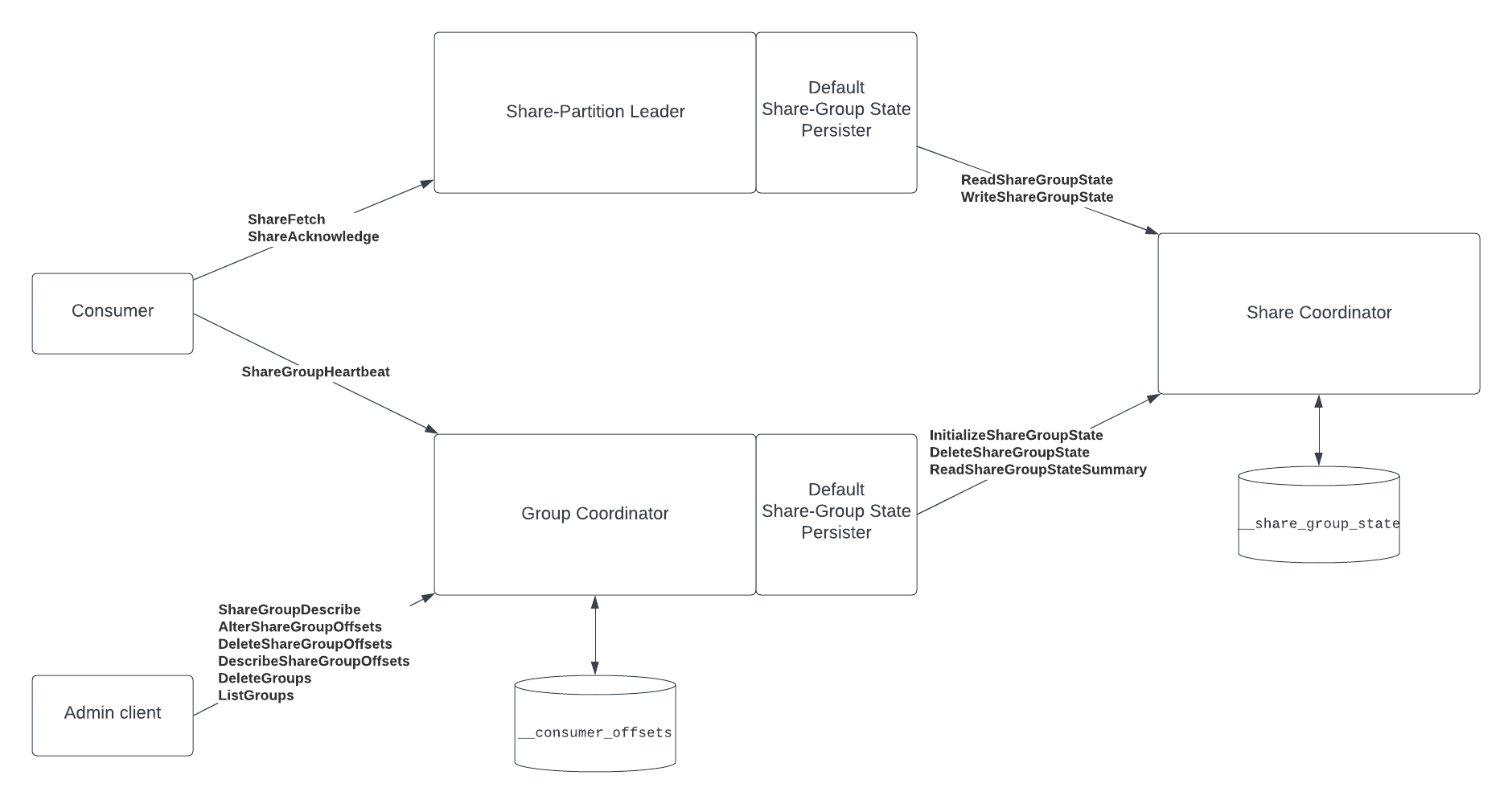
Four components make up a Share Group.
The Group Coordinator manages the Share Group’s member list and decides which Topic-Partitions go to which member, via the SimpleAssignor. It records the group’s metadata (ShareGroupPartitionMetadata, ShareGroupMemberMetadata, ShareGroupStatePartitionMetadata, and so on) into the __consumer_offsets topic.
The Share-Partition Leader is a broker-internal component that reads records from the replica manager and delivers them to consumers. It records Share-Partition state through the Share-Group State Persister.
The Share-Group State Persister is the component that communicates with the Share Coordinator.
The Share Coordinator manages the persistence of Share-Partition state, writing state (ShareSnapshot, ShareUpdate) into an internal topic, __share_group_state.
Share Group Membership
The core protocol behind Share Groups builds on KIP-848: The Next Generation of the Consumer Rebalance Protocol. Membership is managed by the group coordinator, and consumers signal joining or leaving through heartbeats. Share Groups only support a server-side assignor (org.apache.kafka.coordinator.group.share.SimpleAssignor), and since the concept of fencing doesn’t exist here at all, rebalancing is simpler and has a more limited impact than in a traditional consumer group.
Rebalancing itself is coordinated by the same three epochs as KIP-848. The Group Epoch increments, triggering a rebalance, whenever a member joins or leaves, a subscription changes, an assignor updates, or partition metadata changes. The Assignment Epoch is the number the group coordinator attaches when it computes a new Target Assignment from the Group Epoch. Each member incrementally converges its Current Assignment toward that Target Assignment, and that progress is reflected in its Member Epoch.
One notable difference is that Share Groups have no concept of Static Membership.
SimpleAssignor
A Share Group needs an assignor to distribute partitions, and KIP-932 currently ships exactly one: SimpleAssignor. It works to keep the number of consumers assigned to each partition as even as possible. Walking through what happens as members join one at a time makes the behavior clear.
| State Change | Subscribed Members | Topic:Partitions | Assignment Change | Resulting Assignment |
|---|---|---|---|---|
| M1 subscribes to T1 | M1 | T1:0 | Assign partition 0 to M1 | M1 → T1:0 |
| M2 also subscribes to T1 | M1, M2 | T1:0 | Co-assign partition 0 to M2 | M1 → T1:0 / M2 → T1:0 |
| T1 gets 3 more partitions | M1, M2 | T1:0-3 | Assign 2 to M1, 1 and 3 to M2, reclaim 0 from M2 | M1 → T1:0,2 / M2 → T1:1,3 |
| M3 subscribes to T1 | M1, M2, M3 | T1:0-3 | Reclaim 2 from M1, assign to M3 | M1 → T1:0 / M2 → T1:1,3 / M3 → T1:2 |
| M4 subscribes to T1 | M1-M4 | T1:0-3 | Reclaim 3 from M2, assign to M4 | M1→T1:0 / M2→T1:1 / M3→T1:2 / M4→T1:3 |
| M5-M8 subscribe to T1 | M1-M8 | T1:0-3 | Co-assign 0,1,2,3 to M5,M6,M7,M8 respectively | 8 members split 4 partitions, two members per partition |
| Everyone but M2 leaves | M2 | T1:0-3 | Assign 0, 2, 3 to M2 | M2 → T1:0,1,2,3 |
Once members outnumber partitions, multiple members end up sharing a partition. As members leave, the ones remaining absorb the freed-up partitions. The assignor keeps rebalancing toward even coverage.
No Ordering Guarantee
Because multiple consumers can process the same partition at once, Share Groups don’t guarantee record ordering. If ordering matters for your workload, stick with a regular consumer group.
Batch Processing
By default, lifecycle is managed per record, but you can also work in batches to push throughput higher: fetch a batch of records, process it, then acknowledge every record in the batch at once.
Reading Transactional Records and Exactly-Once
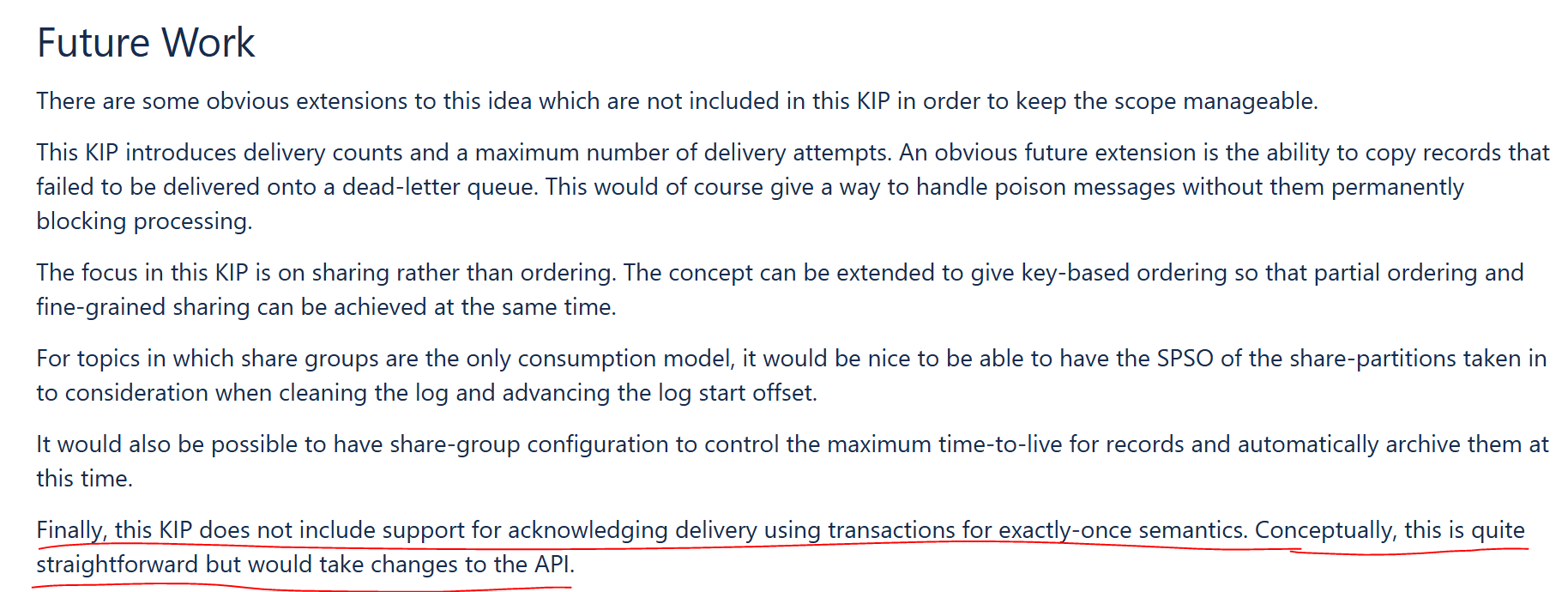
A regular consumer group lets each consumer set its own isolation level. In a Share Group, isolation level can only be set at the group level. And right now, Share Groups don’t support exactly-once semantics, though support appears to be under consideration.
Example Code
Properties props = new Properties();
props.setProperty("bootstrap.servers", "localhost:9092");
props.setProperty("group.id", "myshare");
props.setProperty("share.acknowledgement.mode", "explicit");

KafkaShareConsumer<String, String> consumer = new KafkaShareConsumer<>(props, new StringDeserializer(), new StringDeserializer());
consumer.subscribe(Arrays.asList("foo"));
while (true) {
    ConsumerRecords<String, String> records = consumer.poll(Duration.ofMillis(100));    // Return a batch of acquired records
    for (ConsumerRecord<String, String> record : records) {
        try {
            doProcessing(record);
            consumer.acknowledge(record, AcknowledgeType.ACCEPT);                       // Mark the record as processed successfully
        } catch (Exception e) {
            consumer.acknowledge(record, AcknowledgeType.REJECT);                       // Mark the record as unprocessable
        }
    }
    consumer.commitAsync();                                                             // Commit the acknowledgements of all the records in the batch
}
KafkaShareConsumer polls records, acknowledges each one ACCEPT or REJECT depending on how processing went, then commits the whole batch at once. The loop looks much like a regular KafkaConsumer loop.
Current Status
Kafka for Queues shipped as Early Access in 4.0. The RPC spec isn’t finalized yet, with 4.1 targeted for that. At this stage, it’s not recommended for production use.