This post summarizes LightMem: Lightweight and Efficient Memory-Augmented Generation.
The easiest way to give an LLM agent memory of past conversation is to include the whole history in the prompt every time. That becomes harder to sustain as conversations grow. A long context triggers the “Lost in the Middle” problem, where the model ignores information buried in the middle, and memory systems that re-read the accumulated history on every turn pay for it with higher compute and slower responses. LightMem targets both problems at once. It’s a lightweight memory-generation system that cuts token usage to a fraction of what existing systems need, while outperforming them.
A Three-Tier Structure Modeled on Human Memory
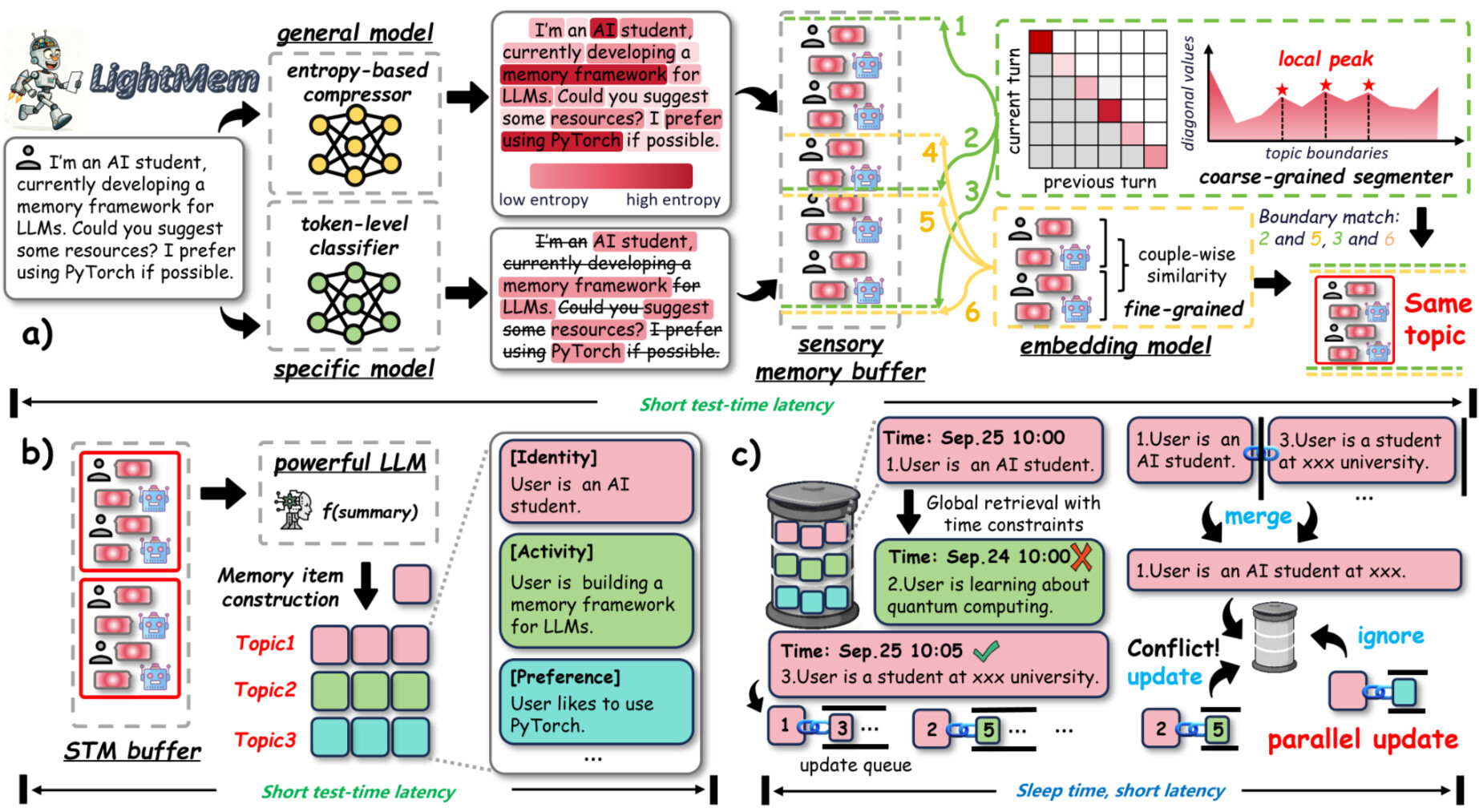
LightMem’s architecture draws on the Atkinson-Shiffrin memory model from 1968. Just as human memory splits into sensory memory, short-term memory, and long-term memory, LightMem processes conversation history through three matching layers: sensory memory, topic-aware short-term memory, and long-term memory. Each layer plays a different role: filtering, grouping, and refining.
Sensory Memory: Stripping Out Dead Weight First
The first stage is pre-compression. The goal is to remove unimportant information from a document or conversation early, reducing the amount of data the remaining stages need to process.
Compression starts by running the input through LLMLingua-2, token by token. LLMLingua-2 assigns each token a retention probability, a score indicating how useful it is to keep, and drops any token scoring below a threshold ($\tau$) without exception. The criterion is information content: LLMLingua-2 keeps tokens with high entropy, the hard-to-predict, information-dense ones, first.

This filtering step removes 50 to 70 percent of all tokens, and semantic coherence survives intact. The information those tokens carry matters, not their raw count.
Topic Segmentation: Splitting Conversation by Meaning
Once LightMem batches compressed sensory memory by turn count, topic segmentation kicks in: it detects where a conversation or document shifts subject and splits the data there. LightMem combines two signals for this, attention and embedding similarity.
The first signal is the attention-based boundary candidate ($B_1$). The LLM computes an attention score for each conversational turn and flags any turn where that score hits a local maximum as a topic shift.
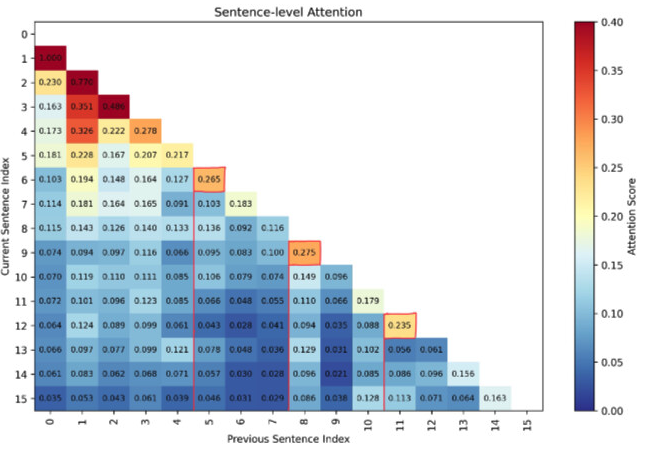
The second signal is the embedding-similarity boundary candidate ($B_2$). When the embedding similarity between adjacent turns drops below a threshold ($\tau$), LightMem flags that point as a shift too.
The final topic boundary ($B$) is the intersection of both candidates.
$$ B = B_1 \cap B_2 $$
Each signal covers what the other might miss on its own. Unlike splitting at fixed intervals, boundaries decided this way capture the specific context each document or conversation has.
Topic-Aware Short-Term Memory
Topic segmentation produces memory fragments split by topic. LightMem pushes these into an STM buffer as $\{topic, \{user_i, model_i\}\}$ pairs, where $user_i$ is the user’s input and $model_i$ is the model’s response.
Once the buffer hits its size threshold, an LLM call summarizes its contents. LightMem stores that summary alongside the original exchanges in long-term memory as $\{topic, \{sum_i, user_i, model_i\}\}$.
Long-Term Memory: Add Immediately, Clean Up Later
Long-term memory uses two update methods, each running at a different time.
Soft update happens during real-time interaction with the user (test-time). LightMem appends new information immediately, without overwriting or deleting anything already there. That temporarily tolerates duplicates, but it avoids response latency entirely. Compare that to the replace approach most existing systems use, which forces extra computation on every update and pays for it in delay.
Sleep-time offline update runs during idle time, when the model isn’t actively serving inference. This is when LightMem performs parallel consolidation across everything stored in long-term memory: sorting all memories chronologically, then using similarity search to find and merge entries that are semantically redundant or contradictory. LightMem only overwrites an existing entry if the new one carries a more recent timestamp, which prevents older information from overwriting newer information.
By appending during interaction and consolidating during idle time, LightMem aims to keep responses fast while maintaining memory quality.
Experiments
LightMem was evaluated under Incremental Dialogue Turn Feeding, an environment that mimics how turns arrive in a live conversation, one at a time. The pre-compressor was LLMLingua-2, running on a lightweight BERT architecture, with the sensory memory buffer set to 512. Evaluation ran on LongMemEval and LoCoMo, against Full Text, Naive RAG, LangMem, A-MEM, MemoryOS, and Mem0 as baselines.
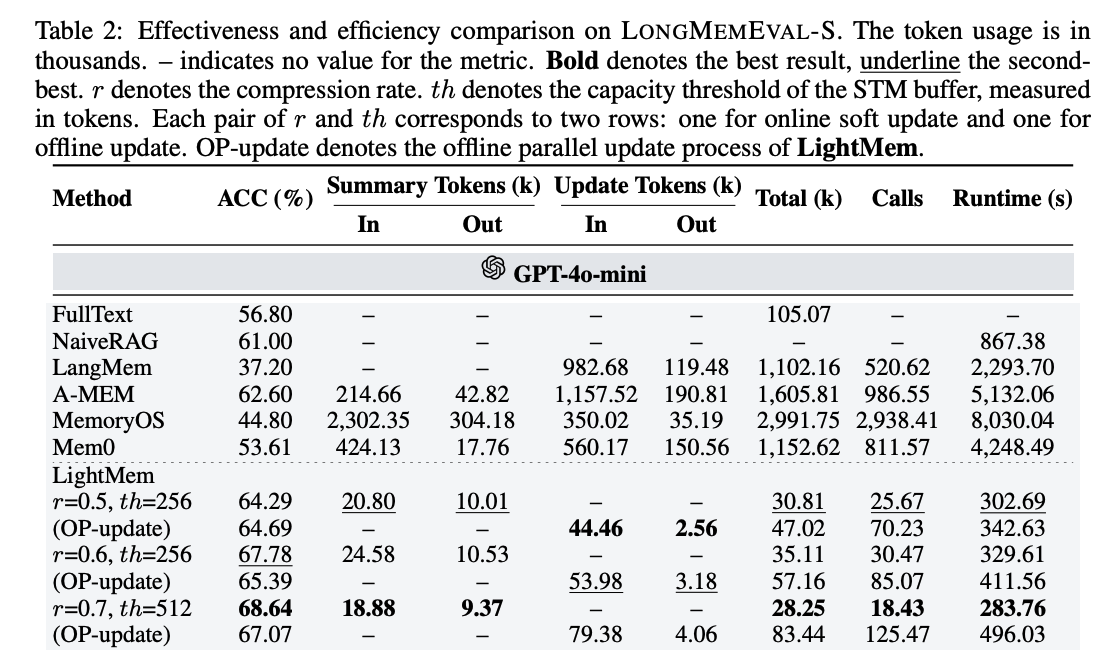
Under identical model conditions, LightMem outperformed every comparison system while using a fraction, in some cases a few percent, of their token budget. Response latency was also lower.
How the Retention Ratio Affects Performance
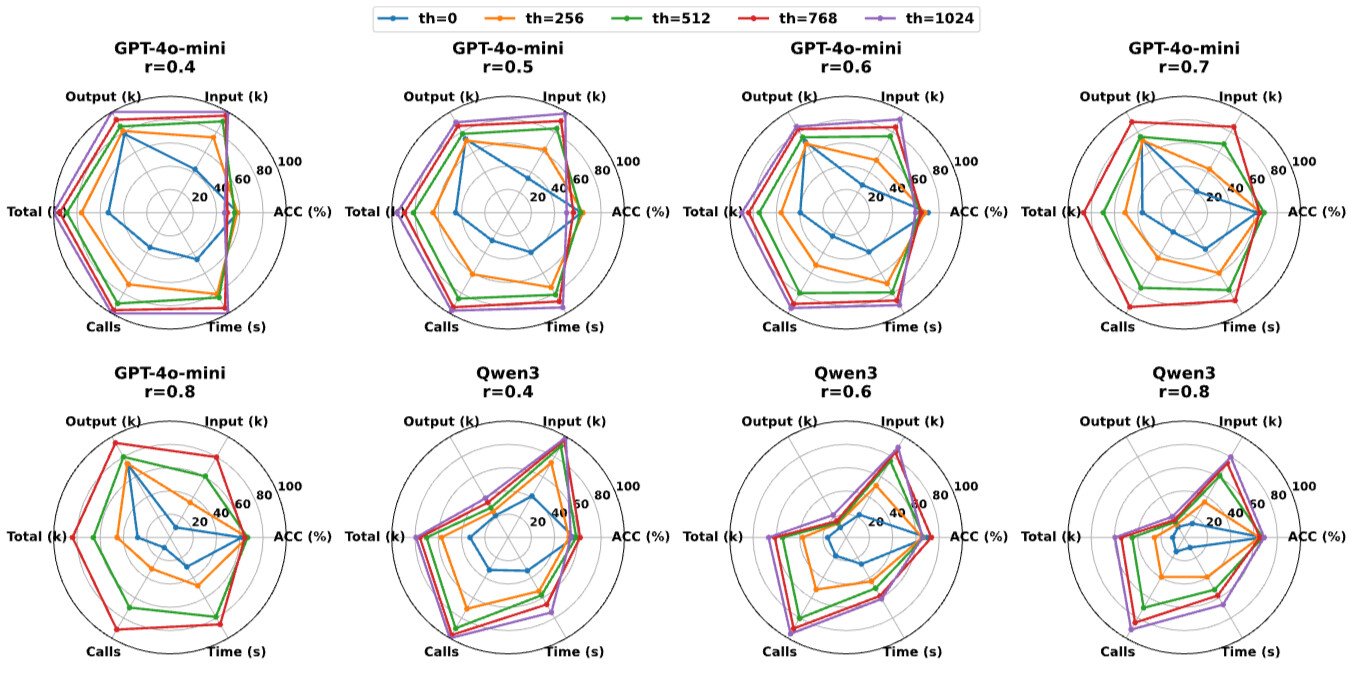
The experiments also varied the retention ratio ($r$), which controls how many tokens survive pre-compression. A higher $r$ lowers the threshold ($\tau$), letting more tokens through. Across the board, $r = 0.6$ performed best, though the ideal value shifted with STM buffer size: smaller buffers favored 0.6, while larger buffers did better at 0.7.