Sparse Matrix & CSR

CSR (Compressed Sparse Row) comes up constantly in graph computation and storage optimization. It first appeared in a 1977 Yale University report, the Yale Sparse Matrix Package, which is why it’s sometimes called the Yale format. It was designed to store and process sparse matrices efficiently. What a Sparse Matrix Is A sparse matrix is one where most of the entries are zero. You run into them across nearly every corner of modern computing: scientific computing, graph theory, machine learning. Real-world data, once you cast it as a matrix, almost always ends up looking like this. Take a social network: even with a million users, any given person typically has around 500 friends. Representing that directly as a matrix would require something on the order of 10^12 entries, roughly 7.3 petabytes. Storage cost balloons far beyond the actual information the matrix carries. ...

April 1, 2026 · 4 min · Donghyung Ko

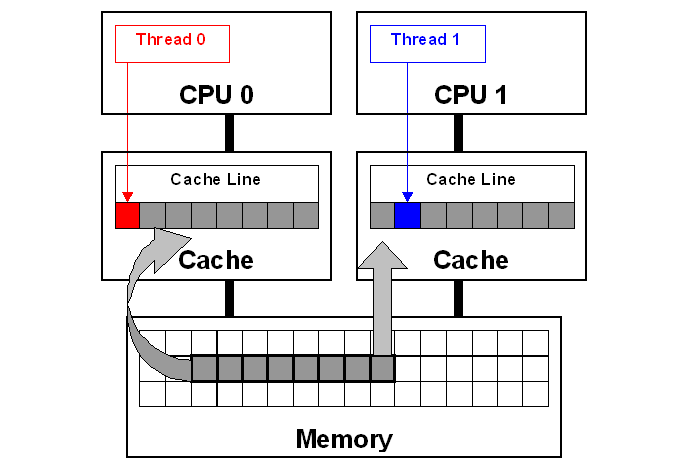
Debugging False Sharing

This post is my own summary of Netflix’s tech blog post Seeing through hardware counters: a journey to threefold performance increase, written the way I understood it, with some background I added along the way. The original post is the authoritative source, so check it directly for exact figures and details. The Problem A Netflix service was running short on CPU, so the team scaled its nodes up 3x. Given the CPU-intensive workload, they expected throughput to scale roughly in step. Instead, they got about a 25% improvement, and tail latency actually got worse. ...

December 12, 2025 · 5 min · Donghyung Ko

Spinlock vs Mutex

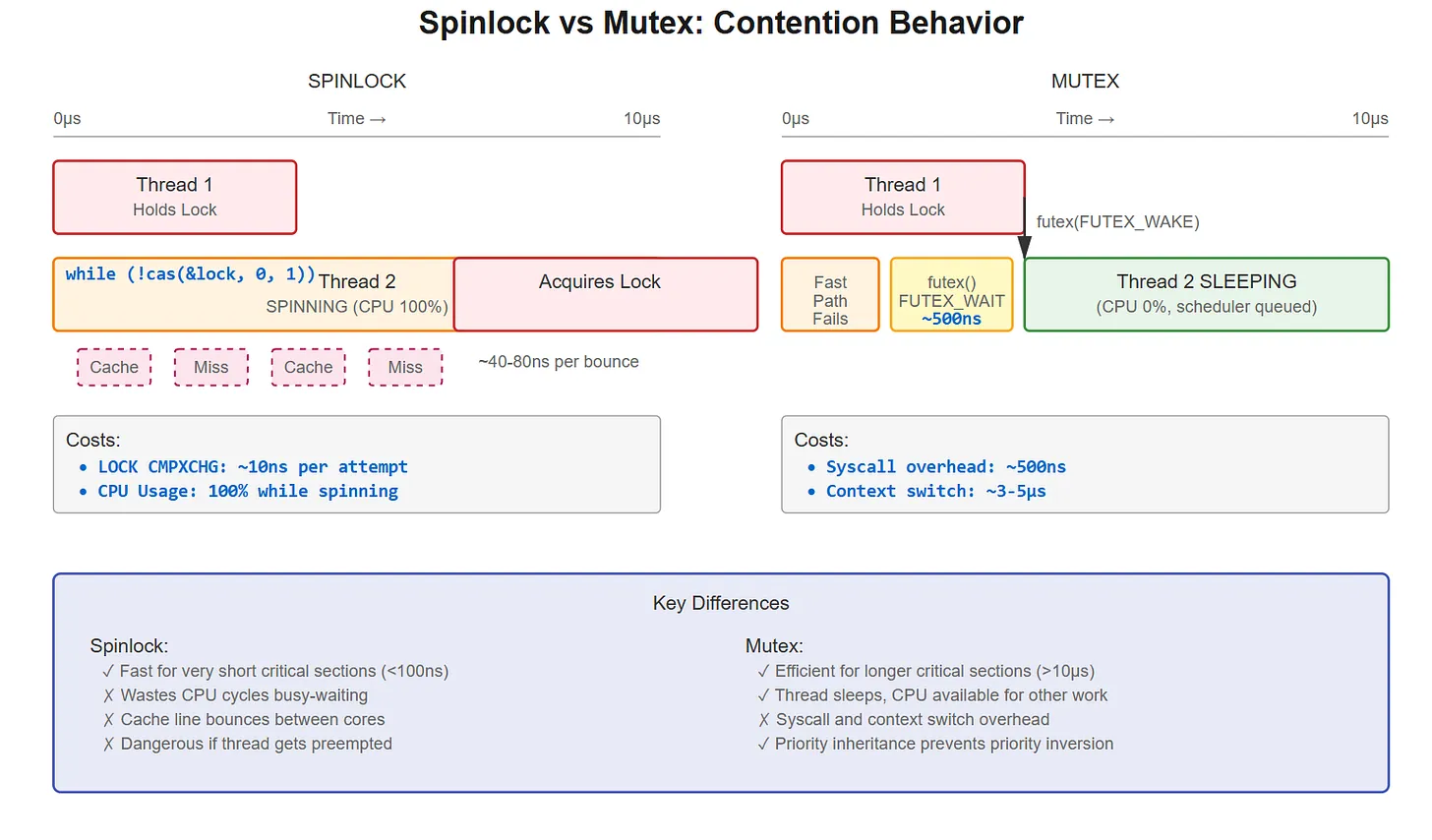
Locks split into two broad families: spinlocks, which run entirely in userspace on raw CPU instructions, and mutexes, which lean on the kernel. Both exist to guarantee mutual exclusion, but they get there differently, and that difference decides which workload each one fits. Spinlock A spinlock lives entirely in userspace. The mechanism is simple: loop forever until a CAS (Compare-And-Swap) succeeds. while (!CAS(lock, 0, 1)) Most CPUs ship a dedicated instruction for this. On x86 it’s LOCK CMPXCHG. The catch is that a CAS only succeeds once the core holds exclusive write access to that cache line. Getting there pulls the cache coherence protocol into play, and passing ownership of a cache line back and forth triggers frequent invalidation, what people call cache line bouncing. That round trip usually costs somewhere between 4 and 80 nanoseconds. ...

December 12, 2025 · 4 min · Donghyung Ko